She Lost the Weight. So Why Didn't She Like Herself?
Want to listen? Click play below.
A few weeks ago, I sat down with a woman for a consultation. As we talked about her health history, she shared that she had recently lost a significant amount of weight with the help of a GLP-1 medication. She had accomplished what so many people dream about. The number on the scale had gone down. Her clothes fit differently. She looked healthier. By almost every measure, she had been successful.
Then she said something that stopped me.
"I thought losing the weight would make me like myself again."
It didn't.
I don't share her story because I think GLP-1 medications are good or bad. They can be an incredibly helpful tool for many people. What struck me wasn't the medication. It was the belief underneath her words.
Like so many women, she wasn't really chasing a smaller body.
She was chasing the feeling she thought a smaller body would finally give her.
We tell ourselves that once we lose twenty pounds, fit back into our old jeans, or finally feel comfortable in a swimsuit, everything else will fall into place. We'll be happier. More confident. More comfortable in our own skin.
Sometimes we lose the weight.
And then we discover the voice in our head never changed.
The criticism is still there.
The self-doubt is still there.
The relationship with ourselves is still the same.
Because weight loss can change your body, but it doesn't always change your relationship with yourself.
After coaching thousands of women for more than a decade, I've become convinced that what many people lose long before they lose the weight is hope.
Not hope that another diet exists. There are thousands of diets.
Not hope that another workout program exists. There are plenty of those, too.
They lose hope that they can change.
After years of starting over every Monday, abandoning meal plans, skipping workouts, and feeling like they've "failed" again, they stop believing they're someone who follows through. They don't just doubt the next diet. They doubt themselves.
That's where I think we need to look differently at the problem.
Imagine you're managing two bank accounts.
One is your Self-Trust Account.
The other is your Self-Doubt Account.
Every time your actions match your words, you make a deposit into self-trust. Every time you keep a promise you made to yourself, no matter how small, you're creating evidence that you can be counted on.
But every broken promise makes a deposit into self-doubt.
"I'll start Monday."
"I'll go after work."
"I'll meal prep this weekend."
On their own, those moments don't seem like much. But over months and years, they accumulate. Without realizing it, you've spent years funding your Self-Doubt Account until it became the louder voice.
So when you decide, once again, that this is the time you're finally going to change, your brain looks at the evidence and says, "We've tried this before."
That isn't because you're lazy.
It isn't because you lack discipline.
It's because your Self-Doubt Account has years of deposits.
The answer isn't to ignore that voice or try to silence it with motivation. The answer is to start funding a different account.
Here's the beautiful part.
You don't need to rebuild years of self-trust today.
You just need to make one deposit.
One walk.
One healthy meal.
One promise kept.
One piece of evidence.
That's how hope begins to return.
Hope isn't wishful thinking. Hope is what happens when you finally have evidence that maybe things can be different. Maybe you're not the person who always quits. Maybe you've simply been collecting evidence for the wrong story.
Every kept promise becomes another reason to believe that change is possible.
Over time, those deposits become self-trust.
And self-trust changes everything.
Not because it magically makes healthy choices easy, but because it changes the relationship you have with yourself. You stop trying to force yourself to change and start taking care of someone you genuinely believe is worth caring for.
That's why I don't think the goal is to lose weight so you'll finally like yourself.
I think the goal is to build a relationship with yourself that makes taking care of your body feel like an act of self-respect instead of self-punishment.
The weight loss may follow.
The confidence may follow.
But they become byproducts, not prerequisites.
If you're tired of starting over, maybe the answer isn't another meal plan.
Maybe the answer is making one small promise and keeping it.
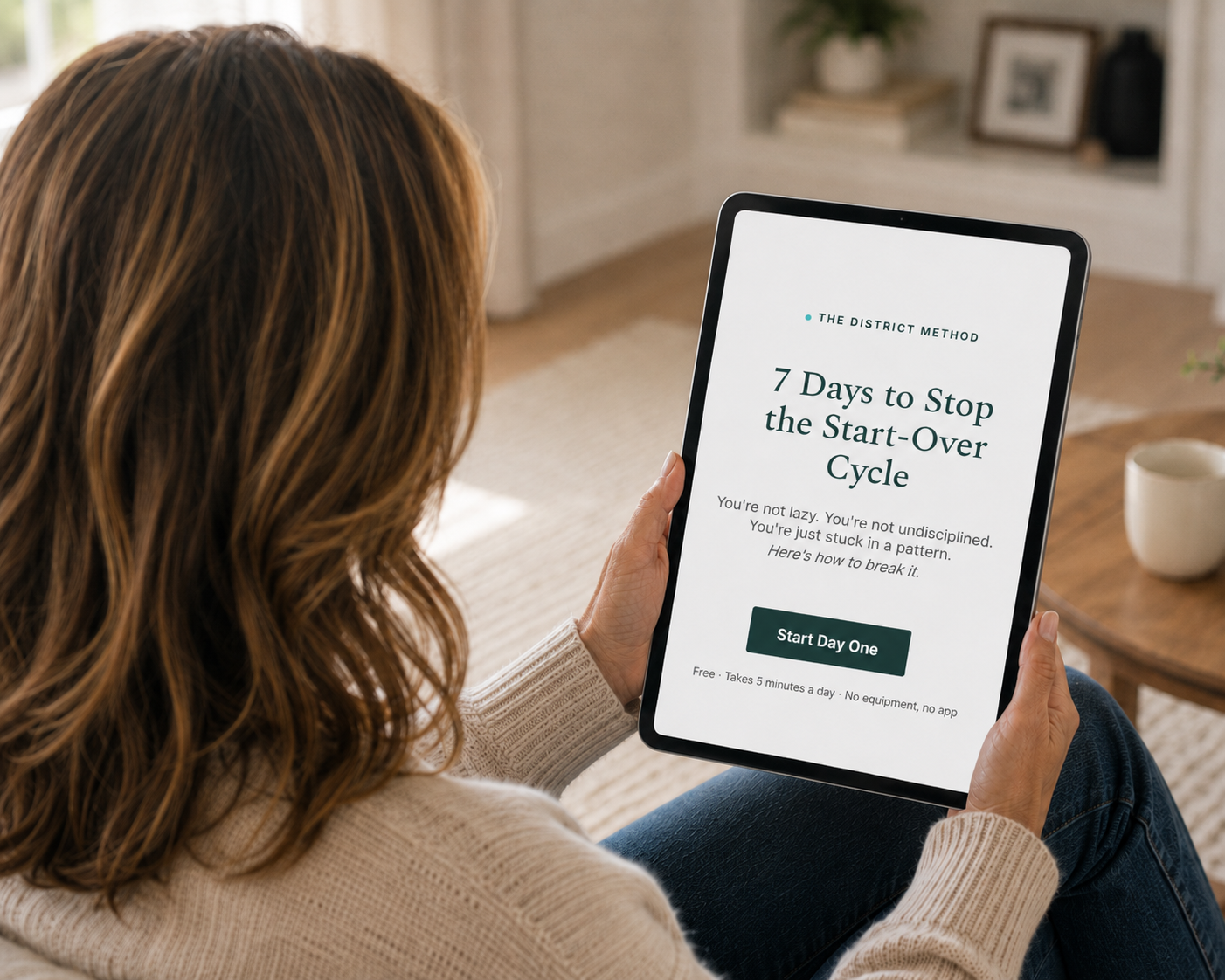
That's exactly why I created 7 Days to Stop the Start-Over Cycle. It's a free guide designed to help you make one small promise each day, keep it, and begin making deposits into your Self-Trust Account.
Seven days won't change your life.
But they might change what you believe is possible.
And sometimes, that's where everything begins.
Get instant access by completing the form below.